
In 2026, programming is the core engine of our digital world. It’s no longer just an “extra skill” on a resume; it has become the “Universal Language” of innovation. If you are asking yourself, “How do I start learning programming from zero?” you are in the right place. This isn’t just a collection of tips—it is a realistic, battle-tested roadmap built for the current high-demand market and emerging technologies.
“Programming isn’t about what you know; it’s about how you think through problems you’ve never met before.”

The First Step: Defining Your “Why”#
Before you dive into the syntax, you must define your target. Are you looking for a high-paying career, building your own startup, or mastering the AI revolution?
What is the actual first step?#
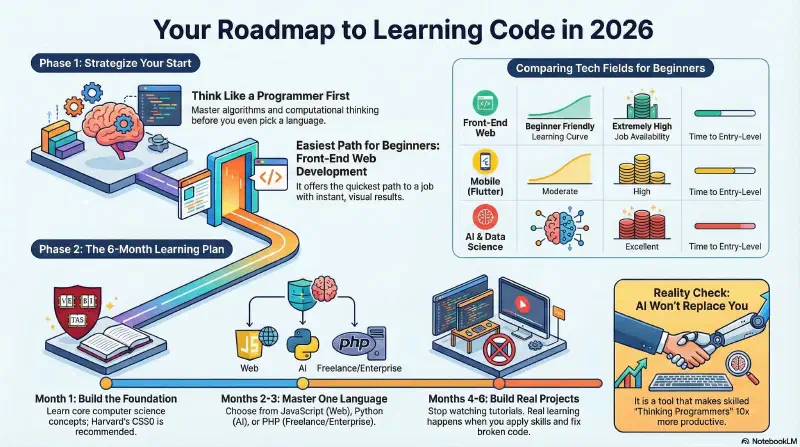
The first step isn’t picking a language; it’s Building a Logic-First Mindset. At its core, programming is the process of breaking a massive problem into tiny, bite-sized steps that a machine can execute.
Essentials to master before you write code:
- Algorithms: The step-by-step logic of solving a problem.
- Data Structures: How to organize and store information efficiently.
- Computational Thinking: Learning to be patient and iterative.
High-Demand Programming Fields in 2026#
The tech landscape is vast. Here are the most lucrative and stable fields to enter this year:
1. Web Development#
Still the undisputed king. Every business on earth needs a web presence, and with the evolution of Web3 and edge computing, this field is more alive than ever.
2. Mobile App Development#
The world lives on smartphones. Whether it’s iOS, Android, or Cross-platform solutions, mobile developers remain in the top tier of earners.
3. AI & Machine Learning#
In 2026, this is the fastest-growing sector. Developers who can build, fine-tune, and integrate AI models are currently the highest-paid professionals in tech.
4. Cyber Security#
As our lives become more digital, the “defenders” of data are indispensable. This is a field for those who love high-stakes problem-solving.
Field Comparison for Beginners#
| Field | Learning Curve | Job Availability | Time to Entry-Level |
|---|---|---|---|
| Front-End Web | Beginner Friendly | Extremely High | 3 - 6 Months |
| Mobile (Flutter) | Moderate | High | 6 - 8 Months |
| AI & Data Science | Steep (Math heavy) | Excellent | 12+ Months |
| Cyber Security | Moderate to Hard | Extremely High | 9 - 12 Months |
What is the Easiest Path for Beginners?#
If you want the quickest path to a paycheck and visible results, the answer is Front-End Web Development.
Why is it the easiest?
- Visual Feedback: You see exactly what you build in the browser instantly.
- Massive Community: Access to millions of free tutorials and components.
- Gentle Start: You begin with HTML and CSS, which are descriptive and less intimidating than “heavy” logic languages.
The Strategic Roadmap: How to Start from Zero#
Follow these phases to avoid the “tutorial hell” and start building real value:
Phase 1: The Foundation (Month 1)#
Understand how computers and the internet actually work. I highly recommend Harvard’s CS50. It is the gold standard for learning how to think like a computer scientist.
Phase 2: Pick Your Weapon (Months 2-3)#
Don’t get distracted. Choose one and master it:
- PHP: My personal favorite and a “web dragon.” It powers over 80% of the web and is the backbone of the freelance market.
- Python: The go-to for AI, automation, and data.
- JavaScript: The absolute necessity for anything web-related.
Phase 3: Practical Application (Months 4-6)#
Stop watching; start building. Create a calculator, a weather app, or a personal portfolio. Real learning happens when the code breaks.
The Web Development Specialization#
1. Front-End (The Visuals)#
- Core: HTML5, CSS3, Modern JavaScript (ES6+).
- Frameworks: React.js or Vue.js.
- Tools: Git & GitHub (Version control is non-negotiable).
2. Back-End (The Engine)#
- Languages: PHP (Laravel), Node.js, or Python (Django).
- Databases: SQL (MySQL) or NoSQL (MongoDB).
Pro Tip: Mastering both makes you a Full-Stack Developer, one of the most versatile and high-paying roles in the industry.
Top 4 Programming Languages to Learn in 2026#
- PHP: The ultimate practical language. We talk about it a lot because it dominates the enterprise and freelance web market.
- JavaScript: You cannot have a modern web without it. Period.
- Python: The king of AI and the easiest syntax for newcomers.
- Rust: The rising star for high-performance, memory-safe systems.
Learn for Free: Best Resources#
You don’t need a $50k degree. Use these:
- FreeCodeCamp: The best “learn by doing” platform.
- Coursera/edX: Access university-level courses (often for free if you skip the certificate).
- Elzero Web School: The #1 Arabic resource for high-quality web education.
- Codzilla: Excellent for simplifying complex tech concepts.
Mobile Learning: Coding on the Go#
Can you learn from a phone? Yes, for the basics.
- Apps: Use Mimo or Sololearn to practice syntax during your commute.
- Cloud IDEs: Replit allows you to write and run code directly in your mobile browser.
- Note: You will eventually need a laptop for professional project builds.
Tech Careers in 2026: Salaries and Opportunities#
The market now values Proof of Skill over a diploma.
- Freelancing: Platforms like Upwork allow you to earn in USD regardless of your location.
- Remote Work: Work for a Silicon Valley startup from your living room.
- Salaries: Entry-level developers in the US/Europe start at $60k-$80k, while experienced seniors easily clear $150k+.
Frequently Asked Questions (FAQ)#
Does programming require advanced math?#
For Web and App development? No. Basic logic and algebra are enough. For AI and Game Dev? Yes, you’ll need Calculus and Linear Algebra.
Will AI replace programmers in 2026?#
No. AI (like GitHub Copilot) will replace programmers who only copy-paste. It will make “Thinking Programmers” 10x more productive.
What is the best laptop for coding?#
Any laptop with at least 16GB RAM (8GB minimum) and an i5/Ryzen 5 processor. If you want to do Mobile dev, a MacBook is highly recommended.
The Bottom Line:
The journey of a thousand miles begins with a single line of code: print("Hello World"). The market is hungry for creators. Don’t wait for the “perfect time”—the perfect time is now.
Ready to write your first line of code? Which field caught your eye? Let me know, and I can provide a specific syllabus for it!