
🎧 You can listen to this article instead of reading it
In the fast-paced world of web development, building a website is no longer just about writing HTML and CSS. Choosing the right “Framework” has become the most critical decision, determining your project’s success in terms of performance, Search Engine Optimization (SEO), and User Experience (UX).
If you are wondering what is the difference between Next and Nuxt? or trying to grasp the core differences between technologies like SSR and SSG, you are in the right place. This article will break down these complex terms in a simple, realistic way.

Why Do We Need Frameworks on Top of Libraries?#
Before we dive into the React vs. Next or Vue vs. Nuxt comparison, we must understand that React and Vue are, at their core, “Libraries” for building user interfaces. However, when building large-scale projects, we need additional features like Routing, Image Optimization, and most importantly: Rendering Strategies. This is where Next.js and Nuxt.js come in to fill the gaps and transform these libraries into full-fledged development ecosystems.
What is Next.js? (The React Ecosystem Giant)#
Next.js is a framework built on top of the React library, developed by Vercel. Its primary goal is to solve the issues of traditional “Single Page Applications” (SPA) that struggle with search engine indexing.
What is the difference between using React alone vs. Next.js?#
When using React alone, you are building an application that relies on Client-Side Rendering (CSR). This means the browser receives an empty page and then downloads JavaScript to build the content.
- The Problem: Search engines might struggle to read the content, and the initial load can be slow.
- The Next.js Solution: It provides Server-Side Rendering (SSR), where content arrives at the browser fully rendered, significantly boosting SEO and speed.
What is Nuxt? (The Gem of the Vue Ecosystem)#
If Next is the hero of React, Nuxt is its counterpart in the Vue.js world. It is an open-source framework that makes building Vue applications more intuitive and organized.
Key Features of Nuxt:#
- Automatic Organization: No need to define routing manually; simply adding a file to the
pagesfolder automatically creates a route. - Native SEO Support: It provides easy tools to manage Meta Tags for every page.
- Multiple Rendering Modes: It supports SSR, SSG, and SPA with ease.
Important Note: Nuxt is not a replacement for Vue; rather, it is an “engine” that gives Vue superpower capabilities to handle servers and optimize performance.
Developer Experience: Why Do Devs Love Nuxt?#
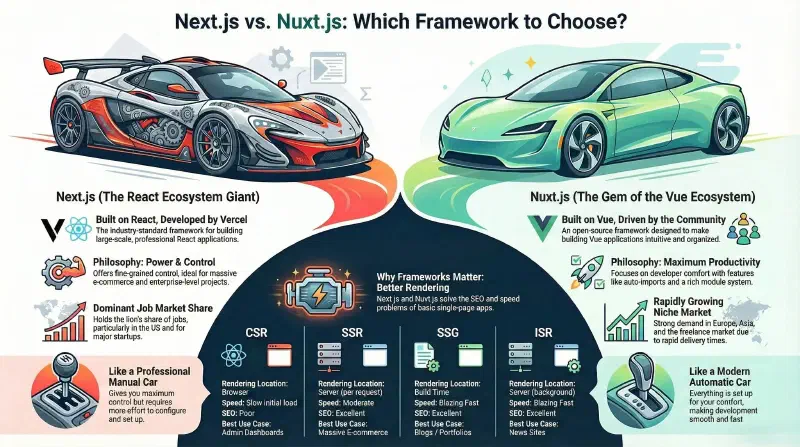
If you ask a Vue developer why they prefer Nuxt, the answer is usually: “Because it makes my life easier.” While Next.js focuses on power and control, Nuxt focuses on Maximum Productivity. Here are the secrets behind its popularity:
- Auto-imports: In Nuxt 3, you don’t need to write
import { ref } from 'vue'in every file. The framework understands your needs and imports functions and components automatically, making the code cleaner. - Module System: Want to add Google Analytics or Tailwind CSS? In Nuxt, there is a “Module” for almost everything that can be installed with a single command, handling all background configurations for you.
- Nitro Engine: The engine running behind the scenes in Nuxt, featuring lightning-fast “Cold Starts” and perfect compatibility with Serverless environments.
Pro Tip: Developing in Nuxt is like driving a modern automatic car—everything is set for your comfort. Next.js is like a professional manual car; it gives you finer control but requires more effort to set up.
Comprehensive Comparison (Next vs. Nuxt)#
Let’s dive into the technical details with this comparison table:
| Comparison Point | Next.js | Nuxt.js |
|---|---|---|
| Base Library | React.js | Vue.js |
| Language Support | JavaScript / TypeScript | JavaScript / TypeScript |
| Developed By | Vercel | Open Source Community |
| Routing System | App Router / Pages Router | File-based Routing |
| Learning Curve | Moderate (Requires React knowledge) | Very Easy (Matches Vue’s simplicity) |
| Market Popularity | Extremely Wide (Highest job demand) | Very Good (Strong in Europe and Asia) |
Web Application Rendering Patterns#
To understand the real difference, you must understand how data travels from the server to the user’s screen. Here is a simplified breakdown:
1. What is an SPA (Single Page Application)?#
In this system (like standard React or Vue), the page loads only once. When navigating, the page doesn’t refresh; instead, JavaScript swaps the content.
- Pros: Fast navigation after the initial load.
- Cons: Poor for SEO.
2. What is SSR (Server-Side Rendering)?#
The server prepares the entire page and converts it to HTML before sending it to the browser.
- Pros: Ideal for SEO; content is visible to the user immediately.
- Cons: Puts pressure on the server as every request requires new processing.
3. What is SSG (Static Site Generation)?#
All pages are built during the “Build” process (before the site goes live), resulting in static HTML files.
- Is SSG faster than SSR? Yes, by a landslide, because the server doesn’t process anything—it just serves a ready-made file.
- Best for: Blogs, documentation, and marketing sites.
4. What is ISR (Incremental Static Regeneration)?#
An evolution of SSG (popularized by Next.js), allowing you to update specific pages after the site is live without rebuilding the entire project.
Quick Summary: SSR vs. CSR vs. ISR vs. SSG#
| Pattern | Rendering Location | Speed | SEO | Best Use Case |
|---|---|---|---|---|
| CSR | Browser | Slow initial load | Poor | Admin Dashboards |
| SSR | Server (per request) | Moderate | Excellent | Massive E-commerce |
| SSG | Build Time | Blazing Fast | Excellent | Blogs / Portfolios |
| ISR | Server (background) | Blazing Fast | Excellent | News Sites |
Where to Host Your Project?#
After coding your site, it’s time to go live. This is where the backing companies shine:
1. Hosting Next.js (The Motherland: Vercel)#
Since Vercel develops Next.js, the hosting experience is magical. Connecting a GitHub repo automatically configures SSR and ISR settings. It also deploys efficiently on AWS Amplify and Google Cloud.
2. Hosting Nuxt.js (Ultimate Flexibility)#
While Nuxt doesn’t have its own hosting platform, it is “everyone’s friend.” The Nitro engine allows you to deploy to:
- Netlify: The preferred partner for Nuxt devs.
- Cloudflare Pages: For global edge performance.
- Standard Linux Servers: Due to its straightforward Node.js handling.
Technical FAQs#
What is the difference between Nest and Nuxt JS?#
A common name-based confusion!
- NestJS: A Backend framework built on Node.js and TypeScript.
- NuxtJS: A Frontend framework built on Vue.js. They are not competitors; in fact, Nest often serves as the API for a Nuxt frontend.
Is Nuxt better than React?#
There is no absolute “better.” The fair comparison is React vs. Vue or Next vs. Nuxt. If you love React’s flexibility and job market power, Next is your choice. If you prefer Vue’s clean code and rapid development, Nuxt will blow you away.
What are the downsides of Nuxt?#
Despite its power:
- Community: Slightly smaller than Next.js.
- Plugins: Some JS libraries require specific “client-only” configurations to work with Nuxt’s SSR.
- Nuxt 3 Migration: The transition from version 2 to 3 had some initial compatibility hurdles.
Market Compatibility: Which One Offers More Jobs?#
Beyond the code, the big question is: “Which tech gets me hired?”
- Next.js Dominance: Due to React’s global grip, Next.js holds the lion’s share of jobs. Most US and Gulf-based startups prioritize Next.js.
- Nuxt’s Rapid Growth: Nuxt is growing impressively in Europe and among specialized firms that value Vue’s “cleanliness.” It is highly sought after in the freelance market for its rapid delivery times.
Job Market Comparison Table:#
| Criteria | Next.js | Nuxt.js |
|---|---|---|
| Job Demand | Very High (Over 60%) | Moderate to Good (Around 25%) |
| Ease of Finding Developers | Easy (Massive Community) | Moderate (Specialized Community) |
| Average Salary | High (Due to large enterprise adoption) | High (Due to occasional talent scarcity) |
Final Recommendation#
Ultimately, the choice between Next and Nuxt is an extension of the React vs. Vue debate. Both are powerhouse tools that have elevated web development to a professional standard.
If your goal is to build a massive e-commerce platform that requires the most stable SEO and a huge hiring pool, Next.js is the industry standard. However, if you want a delightful, high-speed development experience for a medium to large project, Nuxt will provide an unforgettable experience.
Expert Advice: Don’t get stuck in “analysis paralysis.” Pick the tech you feel most comfortable writing. Both frameworks are capable of producing world-class applications.