
Welcome, friend, to the world of Frontend Development. If you are feeling torn between the “Big Three” of the web, believe me—you’re not alone. This article is your comprehensive guide to decoding the differences between React, Vue, and Angular in depth, helping you choose the right tool for your next project or career move.

Introduction: Starting from Zero.. What is a “Framework”?#
Before we dive into the clash of the titans, we need to understand the basics. You often hear terms like “framework” or “library,” but what is the meaning of “framework”? Simply put, what is a framework in programming?
A framework is a “structure” or “template” that provides a set of ready-made tools and rules to build your application. Instead of writing everything from scratch, the framework gives you a system to follow.
What is the difference between a Framework and a Library?#
There is constant confusion between the two, but what is the difference between a library and a programming framework?
- Library: It is a tool that you choose when to call (like React). You are in control of the program flow.
- Framework: It is what dictates how you build the code, and it calls your code at specific times (like Angular, and Vue to an extent).
React vs. Vue vs. Angular: A Comprehensive Overview#
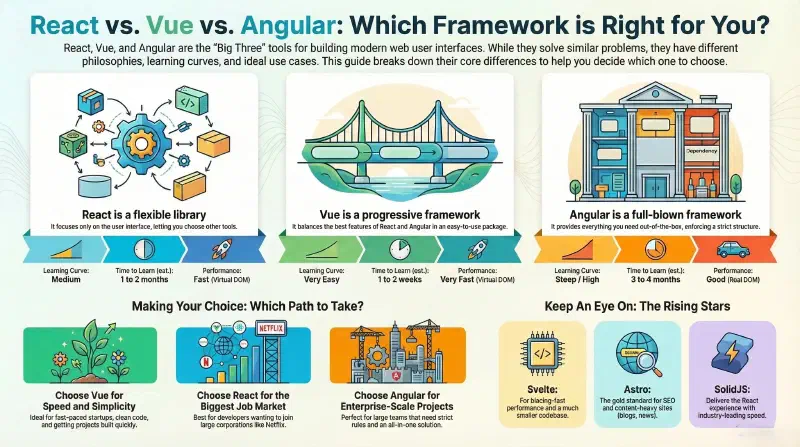
When searching for the difference between React, Vue, and Angular, you will find that each represents a different philosophy in web development.
1. Angular: The Integrated Giant#
Developed by Google, it is a “Full-blown Framework.” It provides everything you need “out of the box”—from routing systems and state management to data handling.
2. React: The Ultimate Flexibility#
Developed by Meta (formerly Facebook). Technically, React is a library, not a framework, focusing solely on building user interfaces. It gives you the freedom to choose your preferred third-party tools.
3. Vue.js: Smart Balance and Elegance#
This is the hero we are focusing on today. Created by Evan You, Vue was designed to be a stunning hybrid that takes the best of Angular and the best of React and delivers them in a simple, easy-to-use package.
Comparison Table: Technical and Practical Differences#
This table summarizes the differences between React, Angular, and Vue directly:
| Feature | React | Angular | Vue.js |
|---|---|---|---|
| Type | Library | Framework | Progressive Framework |
| Developer | Meta (Facebook) | Open Source Community | |
| Language | JavaScript / JSX | TypeScript | JavaScript / HTML / CSS |
| Learning Curve | Medium | Steep / High | Very Easy |
| Performance | Fast (Virtual DOM) | Good (Real DOM) | Very Fast (Virtual DOM) |
| File Size | Small to Medium | Relatively Large | Very Small & Lightweight |
| Flexibility | Extremely High | Opinionated / Rigid | Balanced & Comfortable |
Beyond the Big Three: Rising Frameworks You Should Know#
While the “Big Three” dominate the conversation, a new generation of tools is gaining massive traction by solving legacy complexities. If you want to stay ahead of the curve and make your work stand out, these are the frameworks you need on your radar:
1. Svelte: The Quiet Revolution#
Svelte shifts the heavy lifting from the browser to the build step. Unlike React or Vue, it bypasses the “Virtual DOM” entirely, compiling your code into highly optimized, vanilla JavaScript.
- Why choose it? For blazing-fast performance and a significantly smaller codebase.
- Get started here: Svelte Tutorial
2. SolidJS: Familiar Syntax, Elite Performance#
If you love the React mental model (JSX) but hate the overhead of heavy re-renders, SolidJS is a game-changer. It delivers performance that rivals C++ by using fine-grained reactivity to update only the specific parts of the page that change.
- Why choose it? If you want the React experience with industry-leading speed.
- Get started here: SolidJS Documentation
3. Astro: The King of SEO and Content#
Astro is built for the modern web’s focus on speed. It minimizes the JavaScript sent to the browser using a “zero-JS by default” philosophy. Best of all, it’s framework-agnostic—you can bring your existing React or Vue components into an Astro project.
- Why choose it? It’s the gold standard for blogs, news sites, and any content-heavy platform where SEO is a priority.
- Get started here: Astro Docs
4. Preact: The Lean Alternative#
Think of Preact as React’s high-performance younger sibling. At only 3kb, it offers the same powerful API but with a much smaller footprint.
- Why choose it? For projects where every kilobyte counts, especially when targeting users on low-end devices or slow connections.
- Get started here: Preact Guide
Roadmap: Learning Vue.js from Zero to Hero#
If you decide to take the Vue.js path, here is the professional shortcut to reaching your goal:
Phase 1: The Fundamentals#
Before touching Vue, make sure you master:
- HTML5 & CSS3: The structural and aesthetic foundation.
- Modern JavaScript (ES6+): Focus on Arrow Functions, Destructuring, Modules, and Promises.
Phase 2: The Core of Vue.js#
- Vue Instance & Lifecycle Hooks: Understanding how components live and die.
- Template Syntax: How to bind data to the UI.
- Directives: Learning to use
v-if,v-for,v-model, andv-bind.
Phase 3: Building Components#
- Props & Events: Passing data between Parent and Child components.
- Composition API: The modern, powerful way to write code in Vue 3.
Phase 4: The Ecosystem#
- Vue Router: For navigating between pages without refreshing the browser.
- Pinia: For centralized state management.
- Vite: The fastest tool for building and developing projects.
Why is Vue often considered better than Angular or React?#
What is the explanation of Vue? And why do many prefer it?
- Ease of Learning: If you know HTML, CSS, and JS, you can start with Vue in hours. Is learning Vue.js easy? Yes, it is undeniably the easiest of the three.
- Incredible Documentation: Vue has some of the best documentation in the programming world—clear, organized, and beginner-friendly.
- SFC (Single File Components): In Vue, you write HTML, CSS, and JS in one organized
.vuefile, keeping the code incredibly clean.
Tech Insight: “Vue was designed to be incremental. You can use it for a small part of your site or build a massive full-scale application with it.”
A Trip Down Memory Lane: What does “Vue” stand for?#
You might wonder, what does the acronym V-U-E stand for? Actually, it isn’t an acronym. It is the French word for “view” or “sight,” chosen because the framework focuses primarily on the View Layer of applications.
Frequently Asked Questions (FAQ)#
Does Netflix use Vue or React?#
Netflix primarily uses React for its UI on TVs and browsers because of React’s ability to handle massive amounts of changing components rapidly. However, Vue is used by other giants like Adobe, Nintendo, and GitLab.
Should I learn React or Vue first?#
- If you want to enter the job market quickly at large corporations, learn React.
- If you want a powerful, easy tool to build your own projects or work at fast-paced startups, start with Vue.
How long does it take to learn?#
- Vue: 1 to 2 weeks for a good grasp.
- React: 1 to 2 months (due to the external libraries needed).
- Angular: 3 to 4 months due to its complexity and TypeScript requirements.
Conclusion: Which path will you choose?#
- Choose Vue.js if you seek elegance, simplicity, and development speed. It’s the “smart choice” for developers who value their time and clean code.
- Choose React if you want the largest ecosystem and job market.
- Choose Angular if you are working on enterprise-level projects with large teams that require strict rules.
- Choose Svelte or Astro if you want to build modern personal projects that excel in performance and speed.
Important Note: Remember, the tool is just a means to an end. A professional developer understands the core of JavaScript first, then moves between tools with ease.
How do I start now?#
If you’ve decided to start your journey with Vue.js, follow these steps:
- Learn JavaScript (ES6+) basics.
- Visit the official Vuejs.org site.
- Build a small “Task Manager” app.